

ROLE OF IP LAW (Trademark) IN THE WORLD OF TECHNOLOGY
IP Law in information technology (IT) refers to the legal protection of new software, creator, inventor, or any digital content or product innovation. IP Law uplifts creators and innovators to use their time on invention and unique creation as it requires in this modern era to create an advanced world.
Without IP Law, monetizing the right person who created or invented something is difficult.
Some important terms to know:
1. Intellectual Property Law: It refers to the legal protection of intangible property such as the logo of the company, any artistic or creative works, invention of a particular product, or procedure of the product.
2. Trademark Act 1999: This act Protects the name, sign, logo, tagline, and slogan that represents your company.
3. Intellectual Property: Any intangible property created through innovation, invention, creation, or made through the efforts of humans.
Importance of IPR:
1. Increased creators.
2. Helps to identify the goods and services.
3. Helps to earn Revenue through royalties, and licensing fees.
THE MAIN INGREDIENTS OF IPR INCLUDED:
1. Patent
2. Copyright
3. Industrial Design
4. Trade Secret
5. Trademark
Patent: Any innovation or procedure of innovation is protected by a legal term as a patent. Here are some rules which are kept in mind for the registration of a patent:
1. The invention is not used previously or won’t be disclosed before the registration of the patent.
2. Unique products or procedures are eligible for registration.
Copyright: It gives an owner the exclusive right to copy their work, sell it, display it, use it, and receive a royalty. This includes literary work, artistic work, music, painting, the script of drama, films, and technical or designing diagrams.
Industrial Designs: Those Designs are related to products, devices, or any kind of object and can be in the form of 2D and 3D dimensions. When designing the product or object its functionality and its usage should be kept in mind.
Trade secret: Any kind of knowledge, confidential information, formula, and data are shared with another business party. For eg: NDA (Non-Disclosure Agreement) – This agreement is made for confidential information or any ideas which are obtained from the client that would not be disclosed to another person. Any breach will be penalized under the trade secret.
Trademark: It’s the company's identity which is in any form whether it’s a sign, symbol, or sound. It helps to distinguish a product and services in the market. It’s a substantial ingredient of an IPR. Without a logo, running a business in the market is impossible. There are lots of businesses in the same niche so, it’s difficult to distinguish them without the trademark of the company.
Importance of Trademark:
1. Extra Revenue: Brand recognition and goodwill of that business increase through the logo of the business then as a result franchisee and value of the brand increase therefore, revenue tends to increase for that particular business.
2. Legal Protection: The business’s mark must be legally protected through trademark registration. After the trademark registration, No one has the right to use the trademark without the permission of the owner.
3. Increase Value: Registered trademark increases the value of the business. After registration, it becomes an asset of the company that creates goodwill which can be sold, franchised, or licensed.
4. Worldwide Protection: Registered trademarks won’t only be protected in India but also give protection in other countries as well. It’s possible to register a trademark in multiple countries.
Types of Trademarks:
Several types of trademarks can be used by businesses to protect them from illegal business practices:
Word Mark: It means any word, which identifies the product or service. This mark was used previously when there is starting of the Trademark Act. For eg: Nike, Coca-Cola, Flipkart, and Google.
Design Mark: Any graphic design which represents the business or services. For eg: The apple symbol, Nike Symbol, Pepsi “circular” logo, etc.
Sound Mark: A unique sound that represents a company’s brand or product. For eg: MC Donald’s “I’m Loving It”, a Nokia ringtone, a short ringtone that represents a Nokia phone, etc.
Color Mark: A particular mark that identifies a product or service is called Color Mark. For eg: Coco-Cola’s red color is used on its logo or packaging. The blue color used by Facebook, the green color by Starbucks on its logo, etc.
PROCESS OF REGISTRATION OF TRADEMARK:
The following steps are taken of the process for the process of registration of a trademark in India are:
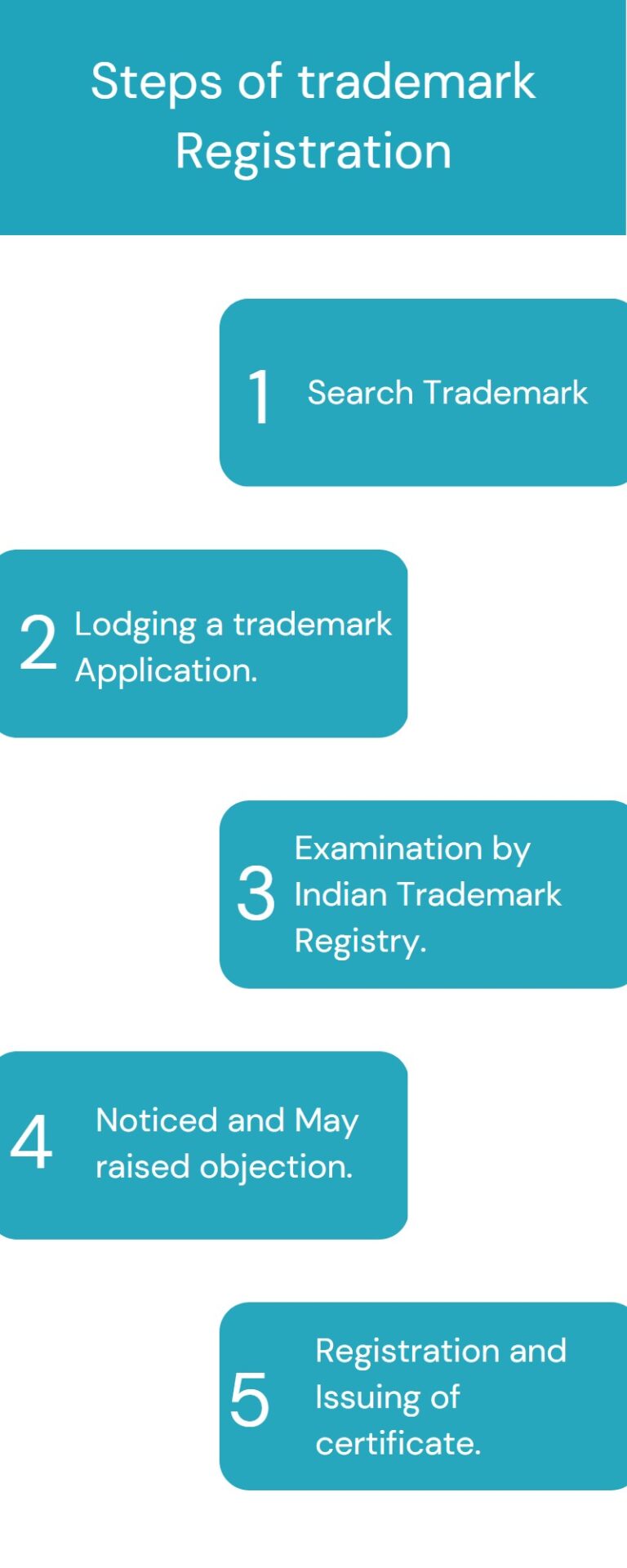
1. Search Trademark: The first step of trademark registration is to search the trademark whether it is registered already by another party or not. If it’s not being registered by another party then it’s validate for use.
2. Lodging of Trademark Application: Some documents are compiled by filling out a trademark application form and submitted to the Indian Trademark Registry.
3. Examination by the Indian Trademark Registry: They ensure that it fulfills the legal requirement for registration and properly examine the trademark, whether it is distinguished or likely to cause any confusion with the existing trademark.
4. Publication of Trademark: After the trademark is approved by Indian Trademark Registry, It will be published in the official gazette of the Indian Trademark Registry.
5. Registration and issuing of Trademark Certificate: If there are no applications then the Indian Trademark Registry issue the trademark certificate and the owner have rights to their trademark from the date of issuance.
Trademark Infringement:
Trademark Act 1999 includes the rules of registration, protection, and penalties against the unauthorized use of trademarks. When an individual or an organization uses a trademark that looks identical and makes the audience confused then it falls under the category of Trademark Infringement.
The Infringement Act is only for those who registered their trademark but those who don’t register their trademark can settle their disputes in court but it comes under the category of injury to the goodwill.
Types of Trademark Infringement:
1. Direct Infringement
2. Indirect Infringement
Direct infringement: An unauthorized person who doesn’t take permission from the holder of the trademark and uses the trademark in such a way, as to create confusion in the minds of a consumer as it looks identical to that of the registered trademark which decreases the revenue of the business is treated as Direct Infringement.
Indirect Infringement: It refers to the unauthorized use of the trademark by indirect means as it creates a vicarious liability, if one individual on behalf of the company is liable for the infringement then the whole company will be liable except for a person who acted in a good faith and without the knowledge of the infringement.
Penalties for Trademark Infringement
infringement of a trademark in severe cases, may face criminal as well as civil charges. Here are the following remedies for trademark infringement in case of civil proceedings:
1. Temporary Injunction: It is imposed when the cases are on trial and it’s important to preserve the status of the brand and take quick action to protect the rights of the owner. It’s for a definite period and maybe until the case is disposed of or the final judgment is delivered.
Here are some examples of trademark infringement:
a. Prohibiting the infringing party from using the trademark.
b. Decree passed against the use of goods and services not to sell, advertise or promote.
c. If another party is not in compliance with the penalty, then a charge may be imposed on them at the discretion of the court.
d. Restricting some of the activities that will make the condition worsen and loss of revenue to the trademark owner.
2. Permanent Injunction: It’s a permanent prohibition after there is no alternative injunction. The following penalties are included in the permanent injunction:
a. Permanently prohibiting the use of a trademark to sell, use, or any form of trade.
b. Order to the person who infringes to withdraw any kind of application and cancel the invoice regarding the sales of goods and services, generate through the use of infringing trademark.
c. Court also has the power to order the infringing party to destroy all the goods and services.
d. The court may direct to an infringing party regarding money given to the trademark when if it occurs any loss or illegal profit to infringing party.
All these penalties depend on the facts, issues, circumstances, and discretion of the court.
3. Damages: The order stated by the court to pay any damages to the trademark owner and its regarding compensation of any loss and also recovery of those profits which are occurring due to the court procedure.
4. Destruction of Infringing Goods: Court may direct the destruction of goods that have been unauthorized used by the infringing party.
5. Accounts of Profits: During a trademark infringement any profit earned by infringement then by the discretion of the court, may all amount should be given to the trademark owner.
Criminal Penalties:
While Trademark infringement is considered a criminal offense. It includes fines, imprisonment, or both as a penalty. Not all Trademark infringements are considered a criminal offenses. Fines, penalties, and imprisonment are depending upon the circumstances and discretion of the court.
The penalty of Rs. 2Lakh and imprisonment of 3 years are imposed upon infringing party.
Furthermore, Sec.104 of the Act applied when falsely applying a trademark to sell any goods and services is punishable with imprisonment of 3 years and a fine of up to 2 lakhs.
Conclusion:
A trademark should be registered as it gives legal protection to the trademark owner. If another party uses the trademark without the permission of the trademark owner, he should be penalized by the court. The trademark has several advantages which include brand recognition and the reputation of a business.
As per the facts and circumstances of the case, the trademark infringement considers civil or criminal. If the case is severe then may have criminal proceedings and accordingly impose fines, penalties, and imprisonment.
Leave a Comment